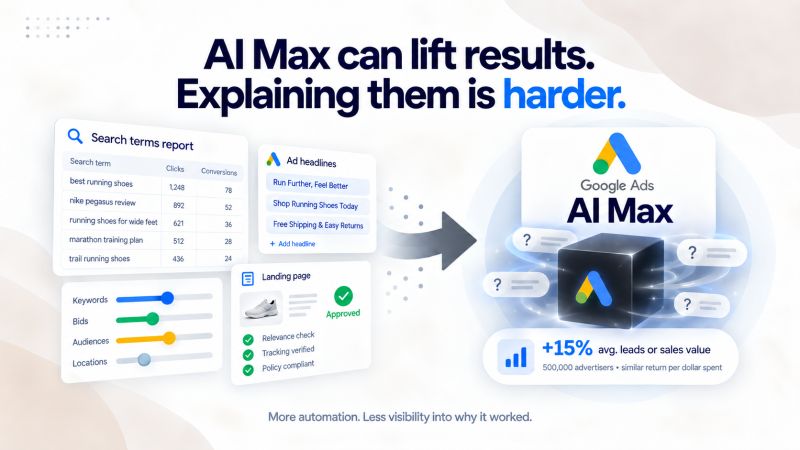
AI Max’s pitch is simple: hand Google more control, get better results. What’s a lot less clear is what exactly you’re handing over, or what to do with it once you have.
Google shared big numbers on its Q2 earnings call. AI Max is out of beta, 500,000 advertisers are on it, and Google says the average lift is 15% more leads or sales value at a similar return per dollar spent. What Google didn’t share is how that 15% is actually generated: how much comes from matching new search terms, how much from automated bidding, how much from creative combinations the system assembles on its own.
With Google advancing more and more on this direction, there’s a few cases where caution is due:
→ A search marketer who could once open a search terms report and see exactly which queries triggered a click now gets a system that blends keyword, broad match, and AI-driven matching into one output. Harder to audit, easier to trust blindly.
→ A brand-conscious advertiser who used to approve every headline-to-landing-page combination now hands that assembly to a system that generates and tests combinations on its own
→ An in-house marketer trying to explain a lead spike to their boss, or an agency explaining one to a client, increasingly has to answer “why did this work?” with some version of “the algorithm decided”
Concretely, here’s what you’re loosening your grip on:
→ match type stops being a hard boundary, since AI Max can match a query it judges relevant even outside your keyword’s exact, phrase, or broad setting.
→ Negative keywords still block some queries, but with less certainty, since the matching logic isn’t purely keyword-text-based anymore.
→ The specific headlines and descriptions you wrote can get supplemented or recombined with AI-generated text tailored to the query, so the live ad isn’t always the copy you approved.
→ And pinning a headline or image to a fixed position carries less weight than it did in a standard responsive search ad, since the system will test combinations on its own.
What’s not resolved:
The actual levers Google gives you to influence AI Max (asset inputs, some exclusions, budget and target settings) are coarse compared to what a fully manual, keyword-based account allowed. There’s no clear public playbook for “how do I get better at AI Max” beyond “feed it more assets and trust the system.”
Google calls this the natural evolution of Search advertising. Fair enough if your team is comfortable running a system you can’t fully see inside. Less true if part of your job is explaining exactly why a campaign performed the way it did, to a client, a boss, or yourself.
If you handed AI Max more control tomorrow, could you actually tell your team why a lead came in, or would “the algorithm decided” be the honest answer?